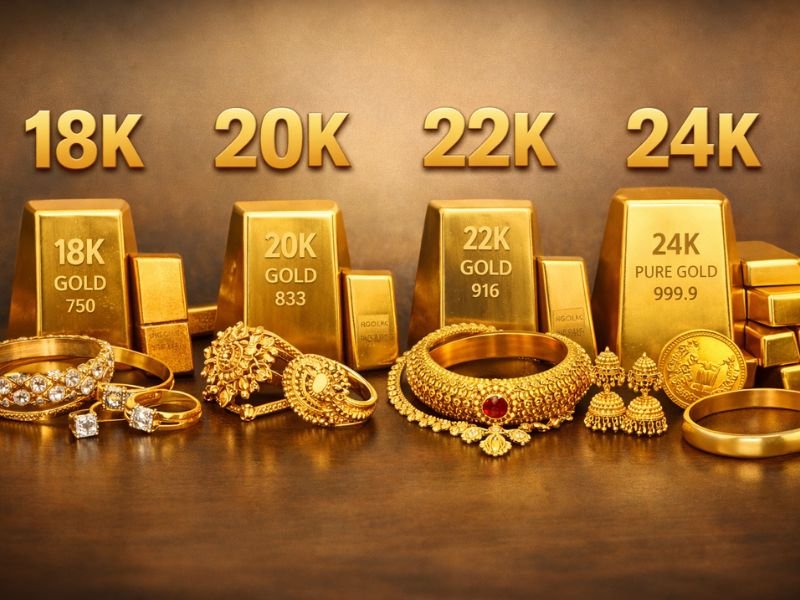
18K, 20K, 22K & 24K Gold Comparison: Purity and Value Explained
Rule2026-02-05T07:53:17+00:00Gold has always played a central role in Indian culture, whether for jewellery, investment, or family inheritance. Yet many people still feel confused when choosing between different gold carats. This is where a clear 18k, 20k, 22k, 24k gold comparison becomes essential.
From understanding purity percentages to knowing which gold gives better resale value, this guide covers everything from beginner to advanced level. If you are buying jewellery, investing, or planning to sell old gold, this article will help you make confident decisions using a practical approach to comparing gold purity.
What Is the Meaning of Gold Carat?
Gold carat, explained in simple terms, refers to the purity of gold. Pure gold is soft, so it is often mixed with other metals to make jewellery durable. The carat system measures how much pure gold is present out of 24 parts.
- 24 carat means 24 out of 24 parts are pure gold
- Lower carats mean a higher alloy percentage
- Carat vs purity is directly linked
This gold carat meaning and purity system forms the base of every gold carat comparison and gold purity guide for selling gold.
Carat Stems From a Medieval Weight Unit of Gold
Historically, gold was measured using carob seeds. Over time, this evolved into the modern karate system. Today, gold purity standards are regulated through hallmark gold purity, especially in India.
Understanding this background helps users better grasp gold fineness explained and the logic behind the gold purity percentage.
Types of Gold Purity Explained (From 18K to 24K)
Below is a detailed breakdown of each gold type to support a complete 18K, 20K, 22K, and 24K gold comparison.
What Is 24-Carat Gold?
- 24k gold purity: 99.9%
- Pure gold content: Highest
- Gold alloy percentage: Almost zero
24K gold purity makes it ideal for investment, coins, and bars. However, it is too soft for daily jewellery use. If your priority is which gold carat has the highest purity, 24K is the clear winner.
What Is 22-Carat Gold?
- 22k gold purity: 91.6%
- Alloy metals: Copper or silver
- Best for: Traditional Indian jewellery
The difference between 22k and 24k gold lies mainly in hardness and durability. 22K is the most popular choice for ornaments in India.
What Is 20-Carat Gold?
- 20 carat gold purity percentage: ~83.3%
- Balanced durability and purity
- Less common but valuable
Many buyers now explore 20k gold purity comparison because it offers a middle ground between strength and gold content.
What Is 18-Carat Gold?
- 18k gold purity: 75%
- Higher alloy content
- Best for: Diamond jewellery
The difference between 18k and 22k gold becomes important for buyers who prefer durability over maximum purity. This also explains 18k gold vs 24k gold use cases.
Gold Carat Comparison Table (Easy Reference)
Below is a simplified gold carat purity chart that helps with quick understanding:
| Carat | Purity % | Pure Gold Content |
| 24K | 99.9% | Highest |
| 22K | 91.6% | Very High |
| 20K | 83.3% | High |
| 18K | 75% | Moderate |
This gold carat comparison table is useful for beginners and advanced users alike and supports gold carat percentage comparison decisions.
18K, 20K, 22K & 24K Gold Comparison for New Jewellery Buyers
A practical difference between 18k, 20k, 22k, and 24k gold depends on purity, usage, and resale value.
- 18K vs 22K vs 24K gold: Durability vs purity
- 20k vs 22k gold: Slight purity difference but noticeable value change
- Gold carat value difference: Higher purity usually means higher resale value
This gold carat value comparison becomes especially relevant when selling old jewellery.
Gold Purity Percentage and Value in India
India follows strict hallmarking norms. A gold purity chart in India helps buyers understand purity before purchase or resale.
Key points:
- Always check the BIS hallmark
- Understand gold content by carat
- Verify the purity of gold jewellery professionally
Knowing how to check gold purity by carat ensures transparency and better pricing.
18K, 20K, 22K & 24K Gold Comparison for Selling Old Jewellery
When selling gold, purity matters more than design. A detailed 18K 20K 22K 24K gold comparison helps sellers estimate value correctly.
Professional buyers like Sona Chandi Buyers evaluate:
- Purity level comparison
- Weight accuracy
- Current market rates
This approach helps customers avoid underpricing and ensures fair deals.
Which Gold Carat Should You Choose?
Choose based on purpose:
- Investment: 24K
- Traditional jewellery: 22K
- Daily wear or diamonds: 18K
- Balanced option: 20K
Understanding types of gold purity simplifies decision-making for every Indian buyer.
How Gold Purity Is Calculated (Beginner to Advanced Explanation)
To truly understand any 18K, 20K, 22K, or 24K gold comparison, it helps to know the simple formula behind gold purity.
Gold Purity Formula: Purity Percentage = (Carat ÷ 24) × 100
Examples:
- 24K: (24/24) × 100 = 99.9%
- 22K: (22/24) × 100 = 91.6%
- 20K: (20/24) × 100 = 83.3%
- 18K: (18/24) × 100 = 75%
This calculation explains gold content by carat and helps buyers understand pure gold content versus gold alloy percentage. It is also the foundation of every gold purity percentage mentioned in jewellery buying or selling.
Karat vs Purity – Clearing Common Confusion
Many people confuse karat with purity. While related, they are not the same.
- Karat: Measures parts of gold out of 24
- Purity: Expressed as a percentage
- Fineness: Often shown as 999, 916, 750
This karat vs purity clarity helps customers read hallmark stamps and understand gold fineness explained on jewellery invoices.
Gold Carat Value Comparison in Real Life
Gold value is influenced by purity, weight, and market rate. A higher gold purity level comparison usually means better resale value.
Key value insights:
- 24K fetches the highest per-gram price
- 22K offers strong resale and wearability
- 20K sits between premium and durability
- 18K has a lower gold value but higher design strength
This gold carat value difference becomes especially important when evaluating old jewellery for resale.
Difference Between 18K and 22K Gold (Buyer Perspective)
The difference between 18k and 22k gold matters based on usage.
- 18K: Stronger, more alloy, lower gold purity
- 22K: Softer, higher purity, traditional appeal
This comparison often comes up when customers debate durability versus gold purity chart values.
Difference Between 22K and 24K Gold (Investment vs Jewellery)
Understanding the difference between 22k and 24k gold helps avoid confusion.
- 24K: Best for investment, not jewellery
- 22K: Best for jewellery, slightly lower purity
Both play different roles in a complete gold purity guide for selling gold.
Hallmark Gold Purity and Indian Standards
In India, hallmarking protects buyers and sellers.
A BIS hallmark includes:
- Carat purity mark
- Assaying centre logo
- Jeweller identification
This system ensures gold purity standards and confirms the purity of gold jewellery before resale or investment.
Gold Purity Comparison for Selling Old Jewellery
When selling old gold, design does not matter as much as purity and weight.
Important points:
- Stones and alloys are deducted
- Purity is tested professionally
- Payment is based on the gold purity percentage
A transparent 18K 20K 22K 24K gold comparison helps sellers estimate fair value confidently.
Why Understanding Gold Carat Explained Matters Before Selling
Many sellers lose value simply due to a lack of knowledge. Knowing the gold carat ensures:
- Better negotiation
- Awareness of deductions
- Trust in evaluation
Experienced buyers like Sona Chandi Buyers focus on educating customers so they understand how purity, fineness, and market rates work together.
Conclusion – Making Smarter Gold Decisions
Gold is more than a metal. It represents value, security, and tradition. By understanding purity, fineness, and usage through this 18K, 20K, 22K, and 24K gold comparison, you can make smarter buying and selling decisions. Whether you are evaluating jewellery, checking hallmark gold purity, or preparing to sell old ornaments, clarity always leads to better outcomes.
With a strong reputation for ethical practices and transparent evaluation, Sona Chandi Buyers helps customers understand gold purity comparison clearly and confidently. We buy gold, silver, diamonds, platinum, and gemstones, ensuring accurate testing and fair valuation based on real purity, not assumptions. Many sellers trust us because every transaction is handled with honesty, professionalism, and complete transparency.
To make our services easily accessible and build local trust, Sona Chandi Buyers operates through multiple verified locations, including Dwarka Sector 7, Dwarka Sector 5, Gurugram Sector 31, and Gurugram Sector 42. Each location follows the same ethical standards, advanced purity testing methods, and customer-first approach.
If you are planning to sell gold, silver, or diamond jewellery or want to understand the true value of your assets, connect with Sona Chandi Buyers today. Visit our nearest Google Business Profile or contact our team to receive expert guidance backed by experience, integrity, and market knowledge.
Common Questions About 18K 20K 22K 24K Gold Comparison
The main difference lies in purity. 24K gold is 99.9% pure, 22K is 91.6%, 20K is about 83.3%, and 18K is 75% pure. Higher carat means higher gold content but lower durability.
22K gold is considered best for traditional Indian jewellery because it offers high purity with enough strength for ornaments. For daily wear or diamond jewellery, 18K gold is preferred.
24K gold is very soft and not ideal for regular jewellery. It is mainly used for gold coins, bars, and investment purposes.
24K gold has the highest resale value per gram because of its maximum purity. However, 22K gold jewellery also has strong resale value due to its high gold content.
20K gold contains around 83.3% pure gold. It offers a balance between purity and durability but is less commonly available compared to 18K and 22K gold.
You can check gold purity by:
- Looking for the BIS hallmark
- Checking the carat or fineness mark (999, 916, 750)
- Getting professional gold purity testing done
916 gold means the jewellery is 91.6% pure, which is equivalent to 22K gold. It is commonly used in Indian gold ornaments.
Yes, 18K gold is cheaper than 22K gold because it contains less pure gold. It also has more alloy metals, making it stronger and more suitable for modern designs.
24K gold is best for investment as it has the highest purity and value. Gold coins and bars are usually made from 24K gold.
No, design does not matter much when selling old gold. The value is mainly based on gold purity, weight, and the current market rate.
Gold purity is calculated using this formula:
Purity (%) = (Carat ÷ 24) × 100
For example, 22K gold purity is (22 ÷ 24) × 100 = 91.6%.
Carat shows how many parts of gold are present out of 24, while purity is the percentage of pure gold in the jewellery.
Yes, BIS hallmarking is mandatory in India for gold jewellery and artefacts to ensure purity and consumer protection.
Yes, stones, beads, and non-gold parts are deducted during valuation. Payment is made only for the actual gold weight and purity.
Both serve different purposes. 22K gold is better for jewellery, while 24K gold is better for investment and resale value.